Steve Dresberg
Blood ShotSteve Dresberg, the Garbage King, is presented as a man whose influence rests on control of the waste business and the capacity to make opposition dangerous. At first, his role in Nancy Cleghorn’s killing remains uncertain: earlier threats against Nancy and Caroline Djiak give Warshawski reason to investigate him, but suspicion is not proof. The eventual encounter at the Xerxes plant changes that balance. Dresberg appears there with Art Jurshak, treats Warshawski as a target, and dies in the ensuing confrontation with her.
Identity and Reach
Dresberg’s nickname describes his reach rather than his temperament. Warshawski understands that anyone wishing to bury, burn, or transport refuse in the Chicago area has to include him in the arrangement. His operations span hauling, incineration, storage containers, and landfills. That breadth makes his power difficult to separate from the ordinary infrastructure of waste disposal: a competitor or reformer can challenge one facility and still confront an empire spread across several linked activities.
The account of his reputation is deliberately qualified. Warshawski recalls reports that two independent haulers disappeared after refusing to deal with Dresberg, with some people claiming they were in a Calumet Industrial District landfill. Other reports associate him with an arson attack on a waste-storage shed that led to the evacuation of six South Side blocks. These are rumors, not established findings. Their narrative importance lies in what they convey about the climate surrounding his business: people imagine that challenging him can end in disappearance or public danger, while the means to substantiate such suspicions seem compromised by fear and influence.
Opposition to the Incinerator
Dresberg’s conflict with Caroline Djiak and Nancy Cleghorn predates the murder investigation. Eighteen months before Warshawski questions Caroline, Hugh McInerney took statements from the two women about problems with Dresberg. They had opposed a proposed PCB incinerator and testified that they received death threats for doing so. The proposal was also associated with an alleged sweetheart deal involving the Sanitary District. Caroline’s account makes clear that the opposition seemed ineffectual to her: she believed Dresberg had secured the right people’s support, leaving their testimony unable to change the outcome.
The novel does not establish in these accounts that Dresberg personally issued the threats. It does, however, place the threats in the context of his business interests and the women’s resistance to a project connected to his waste empire. That distinction matters to Warshawski’s investigation. The earlier intimidation supplies a concrete reason to ask whether Nancy’s later work on a recycling center again threatened Dresberg, but it does not by itself identify Nancy’s killer.
McInerney initially says he does not think Dresberg was responsible for Nancy’s death. When Warshawski presses him to consider the recycling center and recalls the earlier death threats, he agrees to contact Dresberg’s attorney and assess his response. Warshawski challenges the ease with which the possibility can be dismissed: a man who objected to opposition to an incinerator might also resist a recycling project that encroached on his operations. Nancy’s former partner likewise sees Dresberg’s reaction as difficult to predict, describing him as protective of any perceived encroachment, including questioning of his business. Neither assessment settles the murder question; together, they explain why Dresberg remains a serious lead.
From Rumor to Suspect
Warshawski recognizes the danger of directing an investigation toward a powerful suspect without adequate grounds. In private, she considers that Dresberg may have had nothing to do with the killing and that focusing on him could divert attention from stronger leads. Yet the alternative is not simple caution: Caroline may not amend her statement to the police, and the information about the earlier threats could otherwise remain outside the investigation. Warshawski weighs those risks while deciding whether to pass on what she knows.
A caller later threatens Warshawski and refers to her ability to swim, warning that no swimmer can make it through a swamp. She asks whether the caller is acting for Dresberg or Art Jurshak, but receives no answer that identifies a sponsor. The threat therefore sharpens the danger around the investigation without proving that Dresberg ordered it. Warshawski continues to distinguish between his frightening reputation, the possibilities raised by Nancy’s work, and evidence that would connect him directly to a particular act.
Murray Ryerson sees the same possibility of an alliance. After hearing Warshawski’s account of the investigation, he warns her to be careful if Dresberg is involved and says he can imagine a connection between Dresberg and Jurshak. Warshawski, in turn, wonders what Jurshak might be doing for Gustav Humboldt beyond handling insurance for him. These remain questions at this stage, not a fully demonstrated account of Dresberg’s relations with either man. The later scene at the plant gives the suspected connection to Jurshak a visible basis, while the public investigation into Humboldt remains a separate thread.
The Xerxes Plant Confrontation
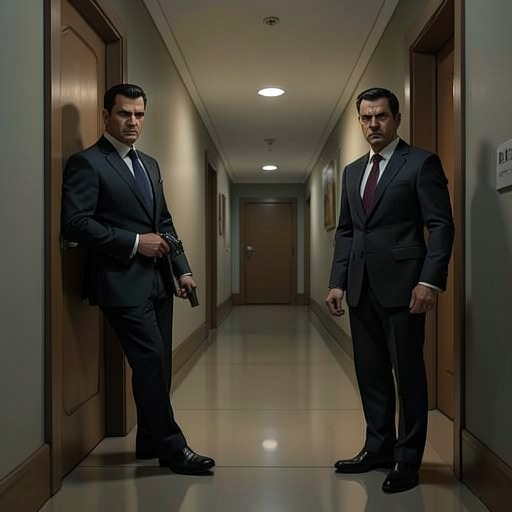
At the Xerxes plant, Dresberg’s alliance with Jurshak is no longer conjecture. He arrives after Warshawski and Florence Chigwell have taken cover, and Jurshak rebukes him for allowing Warshawski onto the site. Dresberg says that she must have entered while he was away speaking with the workers and adds that he will have his men deal with her car after the confrontation. His words show that he is operating alongside Jurshak and treats Warshawski’s presence as a problem to be removed, not as an investigator entitled to question them.
Warshawski calls out that she heard the two men agree that Florence Chigwell was as good as dead, and warns Dresberg that he will have to get through her first. Dresberg fires at the movement around the vat where Warshawski and Chigwell have taken cover. Chigwell’s attempt to distract him gives Warshawski an opening; Warshawski fires twice and hits him in the chest. Even after being struck, Dresberg fires again before collapsing. The scene converts the earlier atmosphere of menace into immediate action: the man previously discussed through allegations and cautions is now openly armed and participating in the confrontation at the plant.
Dresberg’s death occurs amid a wider struggle involving Jurshak and the threatened women at the site. Warshawski then shoots Jurshak as he moves toward Dresberg’s gun. The sequence makes the two men’s cooperation evident, but it does not retroactively establish every earlier suspicion about Dresberg. In particular, the novel’s evidence about the old threats, Nancy’s murder, and the earlier anonymous call remains distinct from what Warshawski witnesses at the plant.
Aftermath and Narrative Significance
Dresberg’s importance comes partly from the way his reputation precedes him. Reports of disappearances and arson, the women’s testimony about threats, and his extensive control of waste operations make him a plausible source of danger long before he enters the final confrontation. The investigation repeatedly tests the difference between a reputation that encourages suspicion and evidence that can support a charge. His appearance with Jurshak resolves one uncertainty about their association, while his death closes off the prospect of questioning him further.
The aftermath leaves other questions unsettled. Warshawski later says she will leave the state’s attorney to sort out the remaining matters when Jurshak and Dresberg come to trial, even as she acknowledges her exhaustion and the limits of what she can pursue. Separately, she tells Humboldt that the Herald-Star is investigating a connection between him and Dresberg; she predicts that the resulting exposure and claims will threaten Humboldt Chemical, but the newspaper investigation and the company’s eventual fate are not resolved in that exchange. Dresberg thus remains central to the novel’s picture of entrenched power: a figure whose business reach and intimidating reputation shape the investigation, whose relationship with Jurshak becomes tangible at the plant, and whose death does not automatically settle every question surrounding the violence and corruption connected to him.